
No resolutions, only metanoia

Three months ago, I moved to Paris to figure my entire life out. You can go ahead and let out a laugh (I’m doing the same). Paris, with its Haussman buildings, its green lounging chairs, its corner boulangeries, and its historic appeal to artists, writers, and philosophers alike. Paris, the birthplace of existentialism and absurdism over apricot cocktails and cigarettes.
I’ve heard it said that, if a city calls to you, it’s because there’s something there for you. Most people probably interpret this as the potential for love. But what if there’s more? What if a city can change the way you approach each day?
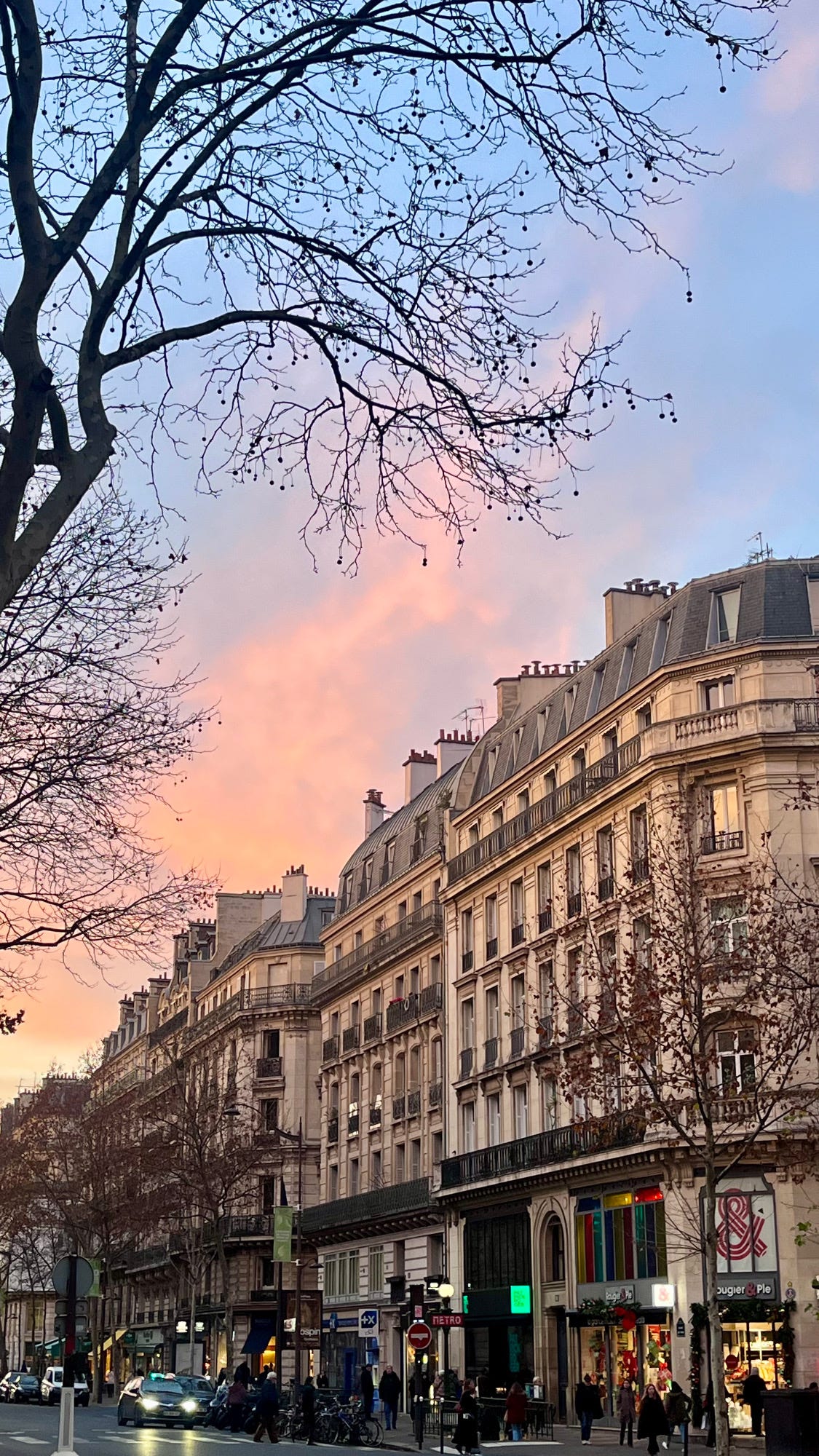
As the new year rolls in, I don’t plan on picking up running or eliminating sugar (god forbid). But I do plan on exploring a shift in personal philosophy, one that started the first time I encountered Nietzsche as a teenager and continues to form like a snowball tumbling downhill in my 30s.
Nihilism is like candy for teenagers. Espousing its rhetoric is the easiest way to say, no one understands me, but Nietzsche, that dude gets it. I remember watching Little Miss Sunshine in high school and feeling a solidarity with 16-year-old Dwayne, a Nietzsche Uberfan who remains in a vow of silence for some of the film. His silence signifies his hatred for basically everyone and everything, and a world that he refuses to engage with.
In hindsight, though it was cool, I never understood how Dwayne’s silence was tied to Nietzsche. If anything, the family’s collective abandonment of societal expectations near the end of the movie is more Nietzschean than Dwayne, who essentially misinterprets nihilism. Perhaps, during those teenage years of my life, my idea of nihilism was just misplaced apathy rather than an understanding of nonexistent meaning.
Nietzsche never touted vows of silence, hating the world, or just doing whatever you want because nothing matters. He told us there is no objective meaning to life, but affirmed life nonetheless. He still thought it possible that the collective could change the course of meaning and that life should still be lived. Though it’s a tempting and palatable outlook for young minds, nihilism also isn’t necessarily an open invitation for hedonism (though that depends on the person and interpretation, I suppose).
There was a quiet shift in my 20s and early 30s that introduced a new way of relating to the world: a conversion to existentialism. Nihilism suddenly felt childish, like a convenience store slushie paid for by my parents’ weekly allowance. Now that I was making my own money, I was making my own way in the world. I equated that with making my own meaning.
Existentialism tells us that, sure, there may not be any inherent or objective meaning of life. But you can DIY it. It’s up to you to find or create meaning and purpose through the choices you make and how you show up in the world. Jean-Paul Sartre and Simone de Beauvoir lived and worked between world wars, influenced by Nietzsche, Husserl, and Kierkegaard, and continued writing in a Nazi-occupied Paris. Their focus on freedom and essence makes sense given the times they lived in.
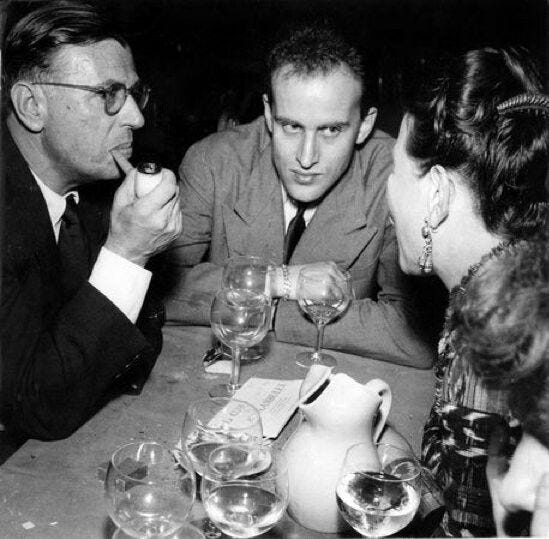
Despite its French origins, something about applied existentialism today strikes me as being quite American. There is a certain pressure to it that feels individualistic to the point of potential paralysis. If I am free to build my own meaning, then I am also responsible for it. There is the burden of choice, the weight of authenticity, and a constant state of hyper-awareness of your own freedom that becomes crushing. Sole authorship is terrifying. Every plot point is monumental. At this time in my life, I was hopping from job to job, trying to make money in industries I didn’t care about, hoping that living comfortably would make room for meaning to emerge.
Each year on my birthday, my friends and I see a Shakespeare play in a beautiful park. For my 35th, it was Hamlet, the story of a Danish prince attempting to avenge his father’s murder. Hamlet spends the entire play overthinking whether to act, spiraling into philosophical paralysis and destructive inaction that ultimately kills nearly everyone, including himself.
I hate to say it, but I saw myself in Hamlet on that starry summer evening. Watching the actor descend into theatrical agony and madness from being in his own head, I realized that my search for meaning had turned into self-surveillance. I’ve always been a multi-passionate person, unable to choose one thing that is my source of meaning and purpose. And what would happen if I didn’t choose right? I had already chosen the wrong career. What if I chose the wrong thing a second time?
Around the same time, I began packing for my move to Paris. I had saved vigorously, left my contract job, and broke my lease. I felt ready to really find purpose this time. And after three months of being here, I can confidently say it hasn’t happened. Not even close. Instead, I ate a baguette every day, read in parks, slowed the fuck down, and had a lot of fun. And somewhere in the middle of all of this, the way I saw the rest of my life unfolding suddenly shifted.
The other day, I read about metanoia, the concept of a dramatic change of heart and mind. We may often change our opinions, but metanoia is more about those moments when there is a fundamental shift in the way we perceive or approach the world. Deeper than intellectual agreement, it’s a reorientation of your entire worldview.
If we’re lucky, maybe each decade of life comes with its own metanoia. For me, nihilism gave way to existentialism, and now, existentialism is moving over to make room for absurdism. Championed by Albert Camus, absurdism acknowledges the same problem existentialism does: there is no inherent meaning. But instead of demanding we create meaning through our individual choices, it tells us that we can embrace the contradiction. We crave meaning in a meaningless universe, and that tension never really resolves. This is why Sisyphus is Camus’ poster boy for absurdism. Condemned to push a boulder up a mountain only to watch it roll back down, forever, Sisyphus finds contentment in the act itself, in the conscious engagement with his fate without needing it to go anywhere. “One must imagine Sisyphus happy”.
And I must imagine myself happy, continuing to create and experience life without knowing where anything will lead. The self-surveillance has loosened. I’m less interested in being the sole author of my meaning and more interested in showing up for whatever’s in front of me, whether that be pottery classes in French, exploring the Musée d’Orsay for the sixth time, or going to book club, just for the fun of it.
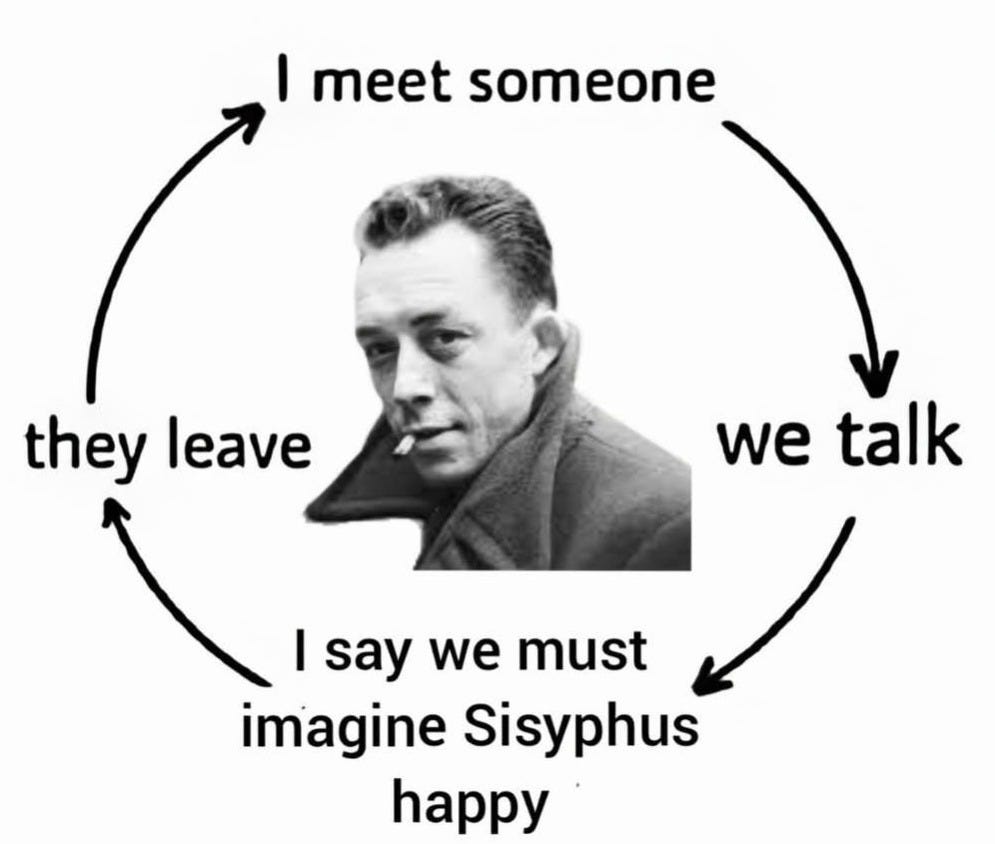
The rock rolls down the mountain. I walk back down. Maybe the sun is out. And maybe this is what people mean when they say a city has something for you. Not love, necessarily. Not answers. Not a completely new version of yourself when January 1st comes around again. Instead, Paris has offered me permission to stop searching quite so hard and just get on with it.
Happy new year, Ivana. I'm glad to read every word in your voice and I appreciate you taking me on this quest where you've chosen to coexist with uncertainty.
I look forward to reading you more <3